Shooting day exteriors in Central Florida means battling an overhead sun that punches through the atmosphere with relentless intensity. Orlando's 90-degree heat and 80% humidity can blow out your highlights and exhaust your crew before you even call action. If you need the right gear to fight back, contact Tiki Grip & Electric at (407) 491-0268 for professional support. Getting your exposure right requires serious firepower.
What Makes the Florida Sun So Difficult to Light?
The Florida sun delivers high-intensity, direct overhead light that causes severe overexposure and harsh shadows. Between June and November, you deal with rapid weather changes and 5600K daylight that shifts dramatically when afternoon thunderstorms roll in. This forces DPs to constantly adjust output and color temperature to maintain matching exposures throughout the day.
You require serious output to compete with this light. Shooting a scene near the reflective glass buildings in downtown Orlando is entirely different from shooting under the heavy oak canopies of Winter Park. The ambient bounce changes the physics of your shot. Your grip equipment rentals need to match the specific environment. A basic reflector board rarely cuts it when you face 10,000 foot-candles of direct midday sunlight. The sheer volume of photons hitting your sensor requires artificial fixtures that can punch back.
Why Choose HMIs for Exterior Shoots?
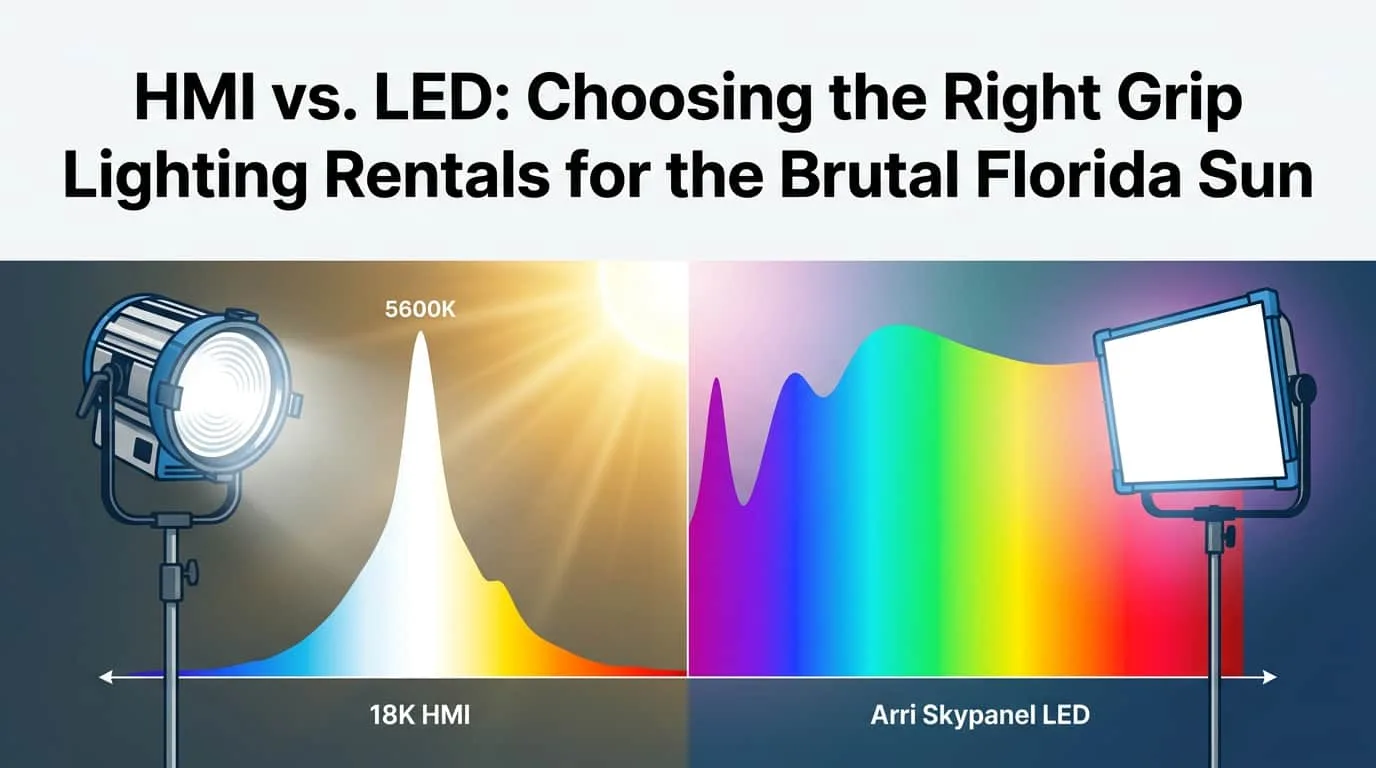
HMIs are the industry standard for fighting direct sunlight because they produce massive output at a daylight-balanced 5600K. A standard 1.2K HMI easily competes with the sun from 20 feet away. These fixtures throw hard, focused light that mimics natural sunlight perfectly on camera.
Hydrargyrum Medium-arc Iodide (HMI) units are your heavy artillery. When you need to bounce light into a third-story window or match the sun's intensity across a wide master shot, nothing beats the raw physics of an HMI. They give you the throw and punch necessary to shape light on a massive scale.
This power comes with a cost. HMIs generate intense heat. On a 95-degree day in Lake Nona, adding an 18K HMI to your set makes the environment even hotter for your talent. You also need serious power distribution. A large HMI requires a tow-plant generator. This adds $300 to $600 to your daily budget. You must also factor in a 10 to 15-minute warm-up and cool-down time for the bulbs. If a ballast fails in the middle of a humid swamp shoot, your production stops entirely. Despite these drawbacks, they remain the best tool for matching raw solar punch.
When Are LEDs the Better Choice?
LEDs are perfect for situations requiring lower power consumption, minimal heat generation, and fast color tuning. You can run high-output LED panels off block batteries, saving you from renting large generators. They also produce almost zero heat, keeping your crew comfortable in tight Florida spaces.
Light-emitting diodes (LEDs) have changed the way we handle grip lighting Orlando, Florida. Modern LED fixtures give you instant on and off capabilities with zero flicker. You can dial your color temperature from 2700K to 6500K with the turn of a knob. This is a massive advantage when a sudden Florida rainstorm shifts your ambient light from warm sunlight to cool, overcast gray in five minutes.
The downside is raw output. A 600-watt LED simply cannot punch through direct midday sun like an HMI. If you try to use a cheaper LED panel to fight the sun on a bright beach day, you will lose the exposure battle. You also risk a green color spike with lower-tier brands. High-quality LEDs that offer clean color rendition often cost just as much to rent as a traditional HMI setup. We find that LEDs shine best as fill light, for interviews, or when shooting in smaller outdoor locations where running heavy cable is impossible.
How Do Location and Budget Affect Your Lighting Gear?
Your specific shooting location and budget dictate your lighting package. Beach shoots require high-output HMIs to compete with sand and water reflection. Urban shoots with limited power access favor battery-powered LEDs. Renting a hybrid lighting package typically costs $500 to $1,200 daily, depending on your specific output needs.
As a DP, you have to look at the logistics before you order gear. Sourcing grip lighting Orlando, Florida, requires planning for power distribution. Do you have access to a 200-amp panel, or are you running entirely off house power? If you plug too many lights into a residential circuit in College Park, you will blow breakers all day long.
In our 32 years of lighting experience, we know that renting the right gear is always cheaper than fixing bad lighting in post-production. A high-CRI LED mat might cost $150 a day, while a 4K HMI package could run $450. You have to weigh those costs against the time you save on set. Renting specialized gear gives you access to the exact tools you require without a massive upfront purchase. Tiki Grip & Electric provides meticulously maintained equipment so you never have to worry about a faulty ballast ruining your shot.
What Is the Best Hybrid Lighting Strategy?
The most effective lighting strategy uses HMIs as your primary key light and LEDs for targeted fill and edge lighting. This hybrid approach gives you the raw punch needed to match the sun while maintaining the fast, tunable control of LED fixtures for close-up talent lighting.
You do not have to choose just one technology. The best Gaffers blend both. You can use an 8K HMI to punch through a 12×12 silk for your wide master shot. This establishes your base exposure. Then, as you move in for close-ups, bring in battery-powered LED panels to wrap soft light around your actor's face.
Always keep your color temperature meter handy. The Florida sun shifts color temperature rapidly as it moves through the hazy atmosphere. By using bi-color LEDs for your fill, you can quickly adjust your color to match the HMI and the ambient sunlight. Using natural reflectors and overhead diffusion nets will also reduce the sheer volume of artificial light you need to bring. Let the sun do the heavy lifting, and use your rented grip lighting Orlando, Florida, to shape and control it.
The Bottom Line on Orlando Film Lighting
The right lighting choice depends entirely on your location, power availability, and the specific needs of your shot. HMIs offer unbeatable power for wide exteriors, while LEDs provide speed, comfort, and precise color control. Combining both allows you the flexibility to handle any Florida shooting environment.
Battling the elements on a film set requires the right tools and a crew that knows how to use them. Whether you are dealing with the intense midday glare or a sudden afternoon downpour, your lighting package must be reliable. Finding the best grip lighting Orlando, Florida, ensures your production stays on schedule and your footage looks professional. Our team maintains all gear to the highest standards, so you get quality performance every single time you call action.
Need help building your next lighting package? Contact Tiki Grip & Electric at (407) 491-0268. With over three decades of production experience, we will help you choose the exact gear to make your next project look incredible.